
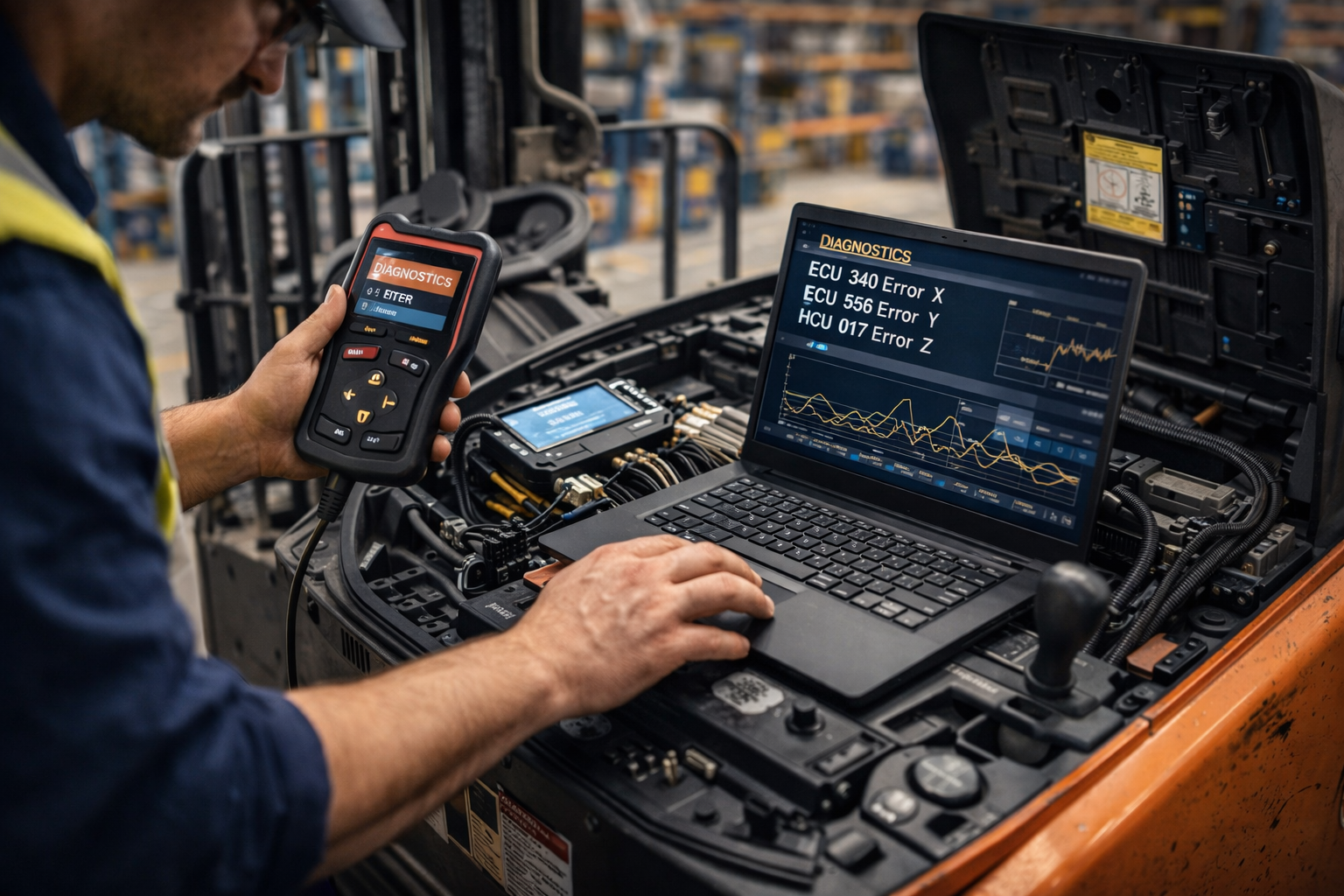
Modern forklifts are no longer purely mechanical machines. Today’s trucks rely heavily on onboard computers, sensors, and electronic control modules to manage engine performance, hydraulics, transmissions, braking systems, and safety features. When something goes wrong, forklift computer diagnostics are often the fastest and most accurate way to find the problem.
Understanding how computer diagnostics work—and why they matter—can significantly reduce downtime, repair costs, and safety risks.
What Are Forklift Computer Diagnostics?
Forklift computer diagnostics use electronic diagnostic tools and software to communicate with a forklift’s onboard control systems. These systems monitor real-time data from sensors throughout the truck and store fault codes whenever a problem is detected.
Diagnostic systems can monitor:
- Engine or motor performance
- Transmission operation
- Hydraulic pressure and solenoid activity
- Brake and steering systems
- Battery management (electric forklifts)
- Safety interlocks and operator controls
Instead of guessing, technicians can quickly pinpoint the root cause of a problem.

Why Computer Diagnostics Are So Important
Forklift issues are not always visible. A truck may still run—but not safely or efficiently. Computer diagnostics allow problems to be identified before they cause major failures.
Benefits include:
- Faster troubleshooting
- Reduced labor time
- Accurate repairs the first time
- Lower repair costs
- Reduced downtime
- Improved safety
In many cases, diagnostics can reveal intermittent issues that would otherwise be missed.
Common Problems Identified Through Diagnostics
Computer diagnostics are especially useful for tracking down complex or electronic-related issues, including:
- Engine or motor derate conditions
- Transmission shifting faults
- Hydraulic solenoid failures
- Sensor malfunctions
- Throttle or accelerator issues
- Overheating conditions
- Battery or charging system faults
- Safety system lockouts
Without diagnostics, these issues often result in repeated breakdowns or unnecessary parts replacement.
Diagnostic Fault Codes Explained
When a problem occurs, the forklift’s computer stores a fault code. Each code corresponds to a specific system or component.
Fault codes can indicate:
- Active faults (current problems)
- Logged or historical faults
- Sensor values outside normal ranges
- Communication errors between control modules
Experienced technicians use these codes along with live data to determine whether the issue is electrical, mechanical, or software-related.

Diagnostics for Electric vs. Internal Combustion Forklifts
Electric Forklifts
Diagnostics are especially critical on electric trucks, which rely on:
- Motor controllers
- Battery management systems
- Encoders and position sensors
- Regenerative braking systems
A single sensor failure can disable the entire truck.
Internal Combustion Forklifts
On propane, gas, or diesel forklifts, diagnostics monitor:
- Engine management systems
- Emissions controls
- Transmission and torque converter behavior
- Cooling system performance
Both types benefit greatly from computerized troubleshooting.
Diagnostics vs. Traditional Troubleshooting
Traditional troubleshooting often involves trial-and-error part replacement, which can be costly and time-consuming. Computer diagnostics reduce guesswork by:
- Identifying the exact failure point
- Showing when and how often a fault occurs
- Providing real-time operating data
- Preventing unnecessary part replacements
This results in more efficient, accurate repairs.
When Forklift Diagnostics Should Be Performed
Computer diagnostics should be used:
- When warning lights or fault indicators appear
- During recurring or intermittent issues
- After major component replacement
- As part of advanced preventive maintenance
- When performance changes without obvious cause
Early diagnostics often prevent expensive secondary damage.
The Cost of Ignoring Diagnostic Warnings
Ignoring fault codes or warning indicators can lead to:
- Sudden breakdowns
- Reduced lifting or travel performance
- Damage to motors, transmissions, or hydraulics
- Safety system failures Increased repair costs
What starts as a minor electronic issue can quickly escalate into a major repair.
Final Thoughts
Forklift computer diagnostics have become an essential part of modern forklift maintenance and repair. As forklifts grow more advanced, accurate diagnostics are the key to keeping them safe, reliable, and productive.
By using proper diagnostic tools and addressing fault codes promptly, businesses can minimize downtime, reduce repair costs, and ensure their forklifts operate at peak performance. In today’s material handling environment, smart diagnostics lead to smarter maintenance decisions.