
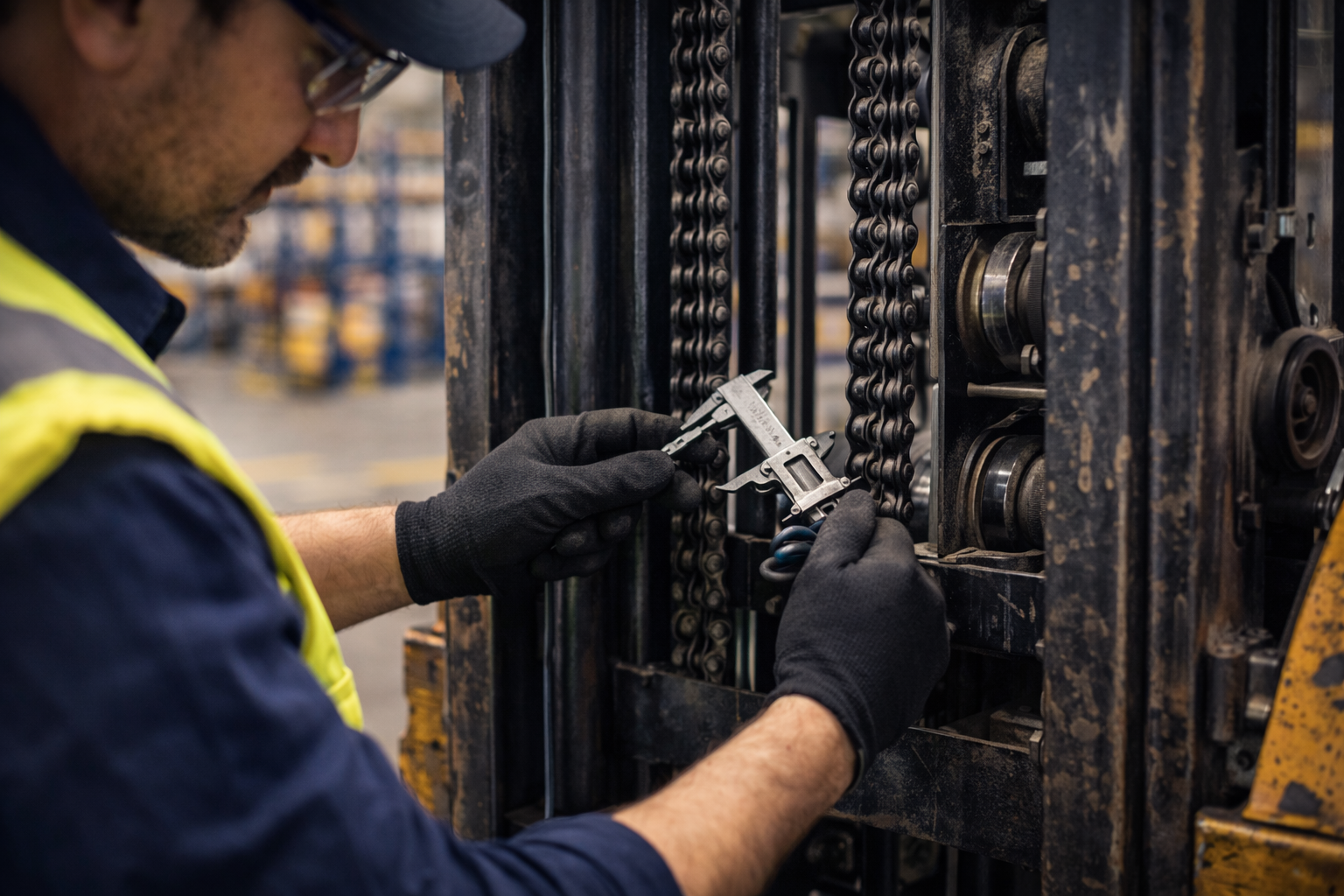
The lifting mechanism is the core function of a forklift—it’s what allows operators to raise, lower, and precisely position heavy loads every day. At the heart of this system are the mast assembly and lift chains, which work together to safely support thousands of pounds above the ground.
Because lift chains and mast components carry constant load and stress, regular inspection and maintenance are critical. Neglecting these systems can lead to serious safety hazards, costly downtime, and catastrophic equipment failure.
How the Forklift Lifting Mechanism Works
A forklift’s lifting mechanism is a coordinated system made up of several key components:
- Mast rails – Vertical channels that guide lifting motion
- Lift cylinders – Use hydraulic pressure to raise the mast
- Lift chains – Transfer lifting force from the cylinders to the carriage
- Carriage and forks – Support and carry the load
- Rollers and bearings – Allow smooth mast movement
When hydraulic cylinders extend, they pull on the lift chains, which raise the carriage and forks. This system must remain perfectly balanced and synchronized to lift safely and evenly.
Why Lift Chains Require Special Attention
Lift chains are load-bearing components, not simple mechanical chains. They are engineered to handle extreme tension, shock loading, and repetitive movement.
Over time, lift chains experience:
- Stretch and elongation
- Pin and bushing wear
- Corrosion from moisture or chemicals
- Loss of lubrication
- Uneven wear between paired chains
Because forklifts rely on multiple chains working together, even minor wear can cause uneven lifting or mast misalignment.
Common Signs of Lift Chain Wear or Failure
Lift chain issues often develop gradually and provide warning signs before failure.
Watch for:
- Uneven fork height when lifting
- Jerky or rough mast movement
- Excessive chain slack
- Rust or corrosion on chain links
- Tight or frozen chain links
- Visible elongation or pin wear
Any of these conditions require immediate inspection.
Safety Risks of Neglected Lift Chains
Lift chains are a critical safety component. Failure can result in sudden load drops or loss of control.
Neglected lift chains can cause:
- Dropped loads
- Mast damage or collapse
- Fork misalignment
- Tip-over hazards
- Severe injury or fatalities
Unlike many other components, lift chain failure often happens without recovery time—making prevention essential.
Lift Chain Inspection and Measurement
Proper lift chain maintenance includes both visual inspection and precise measurement.
Technicians should:
- Measure chain elongation with calipers or chain gauges
- Inspect anchor pins and sheaves
- Check for matching wear between paired chains Inspect chain rollers and mast rails
- Verify proper tension and adjustment
Chains that exceed manufacturer wear limits must be replaced immediately—never adjusted to compensate for excessive wear.
Mast and Lifting Mechanism Maintenance
Lift chains do not operate alone. The entire lifting mechanism must be maintained as a system.
Maintenance includes:
- Lubricating lift chains with approved chain lubricant
- Inspecting mast rollers and bearings
- Checking mast rail wear and alignment
- Inspecting hydraulic lift cylinders for leaks
- Verifying smooth, even lift and lower operation
Neglecting related components accelerates chain wear and compromises lifting safety.
Chain Replacement Best Practices
When replacement is required:
- Always replace chains in matched sets
- Use manufacturer-approved chains only
- Replace worn anchor pins and sheaves
- Properly tension and equalize chains
- Perform load and function testing after replacement
Replacing only one chain in a set creates imbalance and increases failure risk.
Preventive Maintenance vs. Emergency Repairs
Preventive maintenance of lift chains is far less costly than emergency repairs.
Preventive Maintenance Benefits:
- Reduced accident risk
- Longer mast and chain life
- Consistent lifting performance
- Lower total repair costs
Emergency Failures Often Result In:
- Forklift removed from service
- Load and product damage
- Extensive mast repairs
- Serious safety incidents
Routine inspections prevent disasters.
Best Practices for Lift Chain Care
To maximize safety and service life:
- Inspect lift chains daily during operator checks
- Lubricate chains regularly
- Measure chain wear at scheduled PM intervals
- Replace chains before wear limits are exceeded
- Train operators to report lifting irregularities immediately
- Keep detailed inspection records
Lift chains should never be treated as “run-until-fail” components.
Final Thoughts
Forklift lifting mechanisms and lift chains are the foundation of safe material handling. These components carry enormous loads every day, and even small amounts of wear can have serious consequences.
Regular inspection, proper lubrication, accurate measurement, and timely replacement protect operators, equipment, and inventory. In forklift operations, safe lifting starts with well-maintained chains and a properly serviced mast.